News · Doctoral thesis
A new doctor in the emissivity community
On 12 June 2026, Mireia Sainz defended her doctoral thesis, “Advanced experimental study of the optical and vibrational properties of oxide nanoheterogeneous materials,” at the University of the Basque Country (UPV/EHU). The committee awarded the highest distinction: Sobresaliente Cum Laude with International Thesis Mention. The work shows how infrared spectroscopy, paired with rigorous physical modelling, becomes a quantitative tool for reading the structure of inorganic nanomaterials — squarely within the methods this community cares about.

Dr Telmo Echániz Ariceta (Dept. of Applied Mathematics, UPV/EHU)
Dr Jesús Martínez Perdiguero — Secretary (Dept. of Physics, UPV/EHU)
Dr Benoît Rousseau — Member (LTeN, CNRS Nantes)
Abstract
This thesis explores the relationship between the structural characteristics and the infrared optical response of oxide nanoheterogeneous materials. To do so, infrared spectroscopy is combined with physical modelling of the optical permittivity and effective-medium theories, alongside complementary techniques. The work develops methodologies to analyse different oxide nanomaterial systems tailored to specific applications and to extract quantitative structural information.
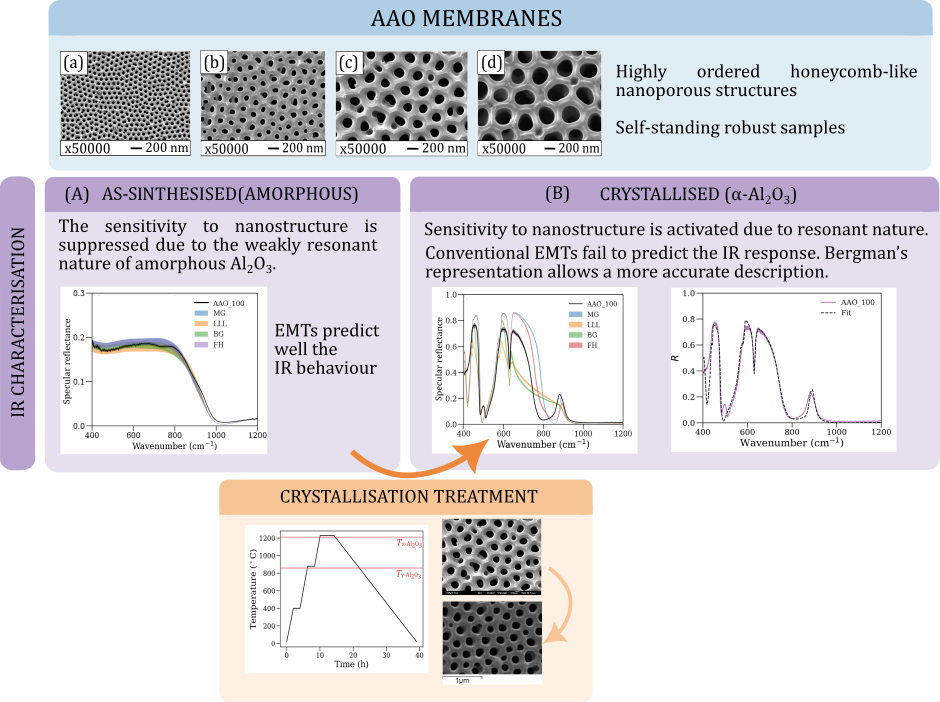
The research is organised into two main blocks: nanoparticle assemblies and nanoporous membranes. The first presents the quantification of the population of structural units in silica nanoparticles; the characterisation of conductivity and the identification of isostructural magnetite and maghemite in iron-oxide nanoparticles; and the development of an attenuated-total-reflection (ATR) methodology to study the dielectric properties of nanoparticle systems. The second focuses on nanoporous amorphous alumina membranes, examining both the dependence of the radiative properties on the nanostructure of amorphous and α-Al₂O₃ membranes, and the phase transition from transition aluminas to α-Al₂O₃ through combined high-temperature Raman measurements and theoretical simulations. In conclusion, the work demonstrates that vibrational spectroscopy, when integrated with rigorous physical modelling, can serve as a quantitative instrument for the characterisation of inorganic nanomaterials.
Graphical abstract
Main conclusions
- A careful combination of IR spectroscopy and homogenisation (effective-medium) techniques is essential to characterise nanoheterogeneous materials.
- Physically-based models for amorphous and crystalline oxides enabled the acquisition of structural information for SiO₂ and iron-oxide nanoparticles.
- Multiple IR methodologies were tested across a diverse range of samples, and a new, accurate ATR approach was developed.
- A successful implementation of Bergman’s theory allows the decoupling of geometric effects from intrinsic optical resonances in nanoporous membranes.
Our warmest congratulations to Dr Sainz, her supervisors, and the examining committee. Work of this kind — turning infrared and vibrational spectra into quantitative structural and radiative-property information — is exactly what advances the measurement and modelling of thermal radiative properties across the network.